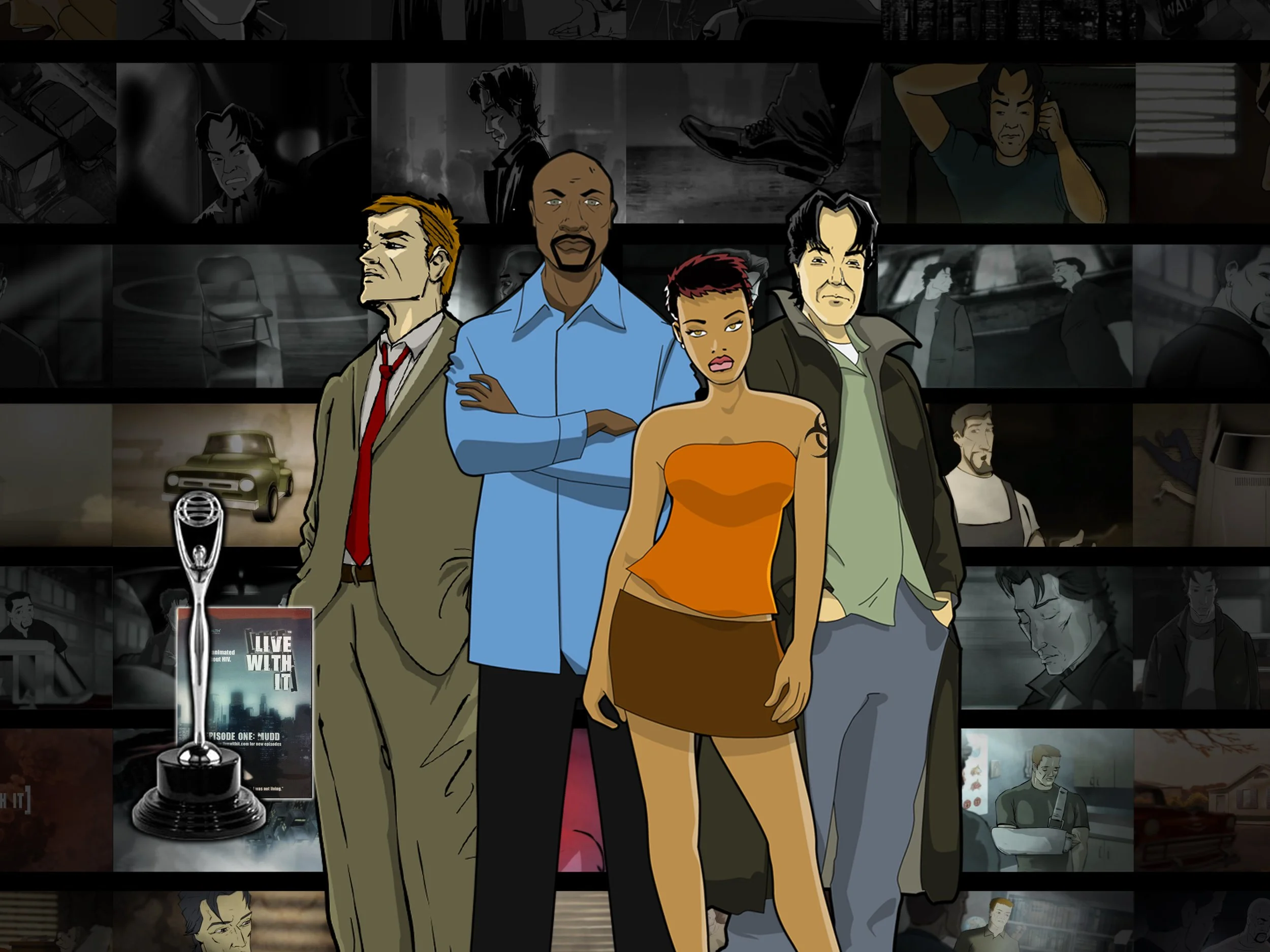
Live With It was born inside a medical marketing agency, not an animation studio. The challenge was to humanize HIV patients in a space shaped by stigma, regulation, pharmaceutical caution, and public misunderstanding. The answer was a web series about five fictional patients learning how to live with an incurable disease, using animation to make a serious health subject more approachable without trivializing it. The result was an early digital-health storytelling project that helped prove cartoons could carry human, medical, and emotional weight.
noise
HIV carried stigma that made direct communication nearly impossible, inside a regulatory environment that made it harder still. Pharmaceutical marketing in this space produced work that was legally cautious to the point of saying almost nothing — enthusiastic about outcomes, silent on specifics, buried in disclaimers.
signal
The people living with HIV needed to see themselves — not a drug, not a warning label. For the message to land, it had to reach patients with enough warmth to reduce shame, while still satisfying a pharmaceutical client's legal obligations.
Scope
We built a fictional world. Five animated characters. One support group. An episodic web series that carried the weight of a terminal diagnosis at a safe enough narrative distance to be honest without triggering the regulatory machinery that would have neutralized it.
The result
Silver CLIO — Direct-to-Consumer, Disease Awareness
WebAwards — Best Advocacy Website
W3 Gold — Animation
MM&M — Best Interactive for Consumers; Best Use of Digital Marketing to Consumer

Production Notes
My, how time flies.
The reason Live With It earns a place in this showcase is twofold: the merits of the project itself, and who I became as a result of making it. So I want to take some time to document the production and to memorialize my tenure at Ignite Health, which I still consider one of the highest points of my career.
Let me tell you a Story
It was the early 2000s. The world had survived Y2K, and the internet was coming alive in ways it hadn't been before. Higher bandwidth meant images and video were reaching millions of screens for the first time. Investment dollars chased every corner of the emerging digital frontier. The result was the long-predicted convergence of traditional and digital media — and it was genuinely new. Nobody had a complete map.
Ignite Health, the agency that birthed this project, was a medical marketing agency — not an animation studio. That distinction mattered more than it might seem. Live With It was the passion project of one of Ignite's founders, Fabio Gratton. His experiment brought together the business logic of the pharmaceutical world, the gravity of patients navigating a terminal disease, and the approachability of cartoons. Not just any cartoons. Serious cartoons. Health cartoons. The vision was ambitious and electrifying, and I was lucky enough to be in the room when it was taking shape.
The Minefield
One of the persistent challenges of healthcare advertising — then and now — is how heavily regulated it is, and rightly so. Claims by drug manufacturers have to be credible and verifiable under FDA guidelines. Benefits and risks must be disclosed with equal visibility. The result is a familiar awkwardness: ads that are enormously enthusiastic about improving your life while saying almost nothing about what the product actually does. Enormous hedges. Endless qualifiers. Results may vary.
To put the scale of this world in context: between 2000 and 2020, spending on direct-to-consumer ads, health services, and professional pharma promotions nearly doubled — from roughly $17.7 billion to over $30 billion annually. It was a serious industry operating under serious constraints.
Now add HIV. A disease carrying stigma unlike almost any other, arriving in a marketing environment already wired for caution. Not only were the legal and regulatory guardrails tighter than usual — the human stakes were higher too. The people this work needed to reach were navigating something incurable, often in silence, often alone.
The Creative Directors, Account Managers, and Principals at Ignite understood the playing field. They also understood that being a maverick — toeing the line between bold and reckless — does not end well in medical marketing. So the answer to how you humanize the patient, address stigma directly, and still nod toward a once-daily HIV treatment became something quieter and stranger and more ambitious: a story about five fictional HIV patients learning how to live with an incurable disease.
A FIve Part Series
Live With It ran for five episodes, each centered on a character whose relationship to the disease — and to each other — unfolded slowly across the arc of the series.
Episode 1 — "Mudd"
Mudd is an anxious, solitary man living with HIV who takes his first step toward coming to grips with his situation by attending a support group.
Episode 2 — "Trevor"
Trevor is the man who runs the support group — steady, present, a quiet anchor for everyone around him.
Episode 3 — "Bobbie"
Bobbie is a former runway model whose lifestyle choices led to addiction and, eventually, to contracting HIV.
Episode 4 — "Julio"
Julio is a car enthusiast who introduces Mudd to the founder of the support group — a man known only as the Invisible Man, so called because even though he never attends the meetings, a chair is always set out for him.
Episode 5 — "The Invisible Man"
The Invisible Man contracted HIV after a blood transfusion following an accident. It is eventually revealed that he founded the support group, and was the mentor who brought Trevor, Bobbie, and Julio back from the brink — guiding them toward treatment and toward living. Though on treatment himself, he is too ill to attend the meetings. The chair remains empty. The group remains.
Credits
Directed by Lucas Stone
Written by D.B. / Michael Spitz
With the Voices of The Invisible Man — Eric Santucci Mudd — Nickolas S'Hakoour Julio — Derek Quinonez
Executive Producer Lucas Stone
Producer Shane M. Brouse
Animation Lawrence Jackson / Rusty Yunusov
Music Alexander Bondarev
Editor Rusty Yunusov
Backgrounds & Illustrations Snakebite / Rusty Yunusov / Lawrence Jackson / Eric Santucci
Storyboard Rusty Yunusov
Technical Coordinator Lawrence Jackson
Sound Engineer Pavel Sinev
Creative Consultants Michael Spitz / Shane M. Brouse
Music & Sound Coordinator Rusty Yunusov
Quality Assurance Anthony Rexsun
Production Assistants Brooke Briggs / Raul "TV" Garcia / Karen Lemmer / Eric Santucci / Kelly Savin / Sean Vassilaros
Website and Web Assets Lucas Stone — Executive Producer Shane M. Brouse — Producer Jeff Heald — Project Manager Kristi Kamei — Art Director Pat Macke — Creative Director Imran Husain — Copywriter Ian Ford — Flash Programming Stephen Weber — Flash Programming David Boyd — Programming Anthony Rexsun / Rupal Kothari — Quality Assurance Arshy Sandhu / Scott Reimonenq — Hosting and Infrastructure
Special ThanksTheBody.com / Aegis.org / Gilead Sciences / Synchronicity Music LA / Graham Ward / Gregg Sartiano / Ignite Health / Les Yates
This film is a work of fiction. Any similarity to persons, places, or events is entirely coincidental.
THe Cost to BuilD
Production was harder than anything I had taken on before. I was an accomplished animator — but I had never worked at this scope. Managing budget, outcomes, expectations, schedules, crew, and the physical and emotional wellbeing of everyone on the team was new territory. I learned to be genuinely cautious about what I commit to — and to understand why that caution is a form of respect, both for the work and for the people doing it.
I was at Ignite Health from 2003 to 2012, during a period when digital media, web standards, online video, and interactive storytelling were rapidly changing what agencies could make. That environment gave me a rare view of what happens when serious healthcare communications, creative freedom, and disciplined production meet. It shaped the kind of studio I would later want to build: one capable of making work that is imaginative, useful, emotionally intelligent, and still delivered under real-world constraints.
It's easy, in retrospect, to see only the awards. What stays with me is the distance between a visionary's idea and a finished thing in the world — and how much time, effort, and trust it takes to close that gap. That distance is where this work actually lives.