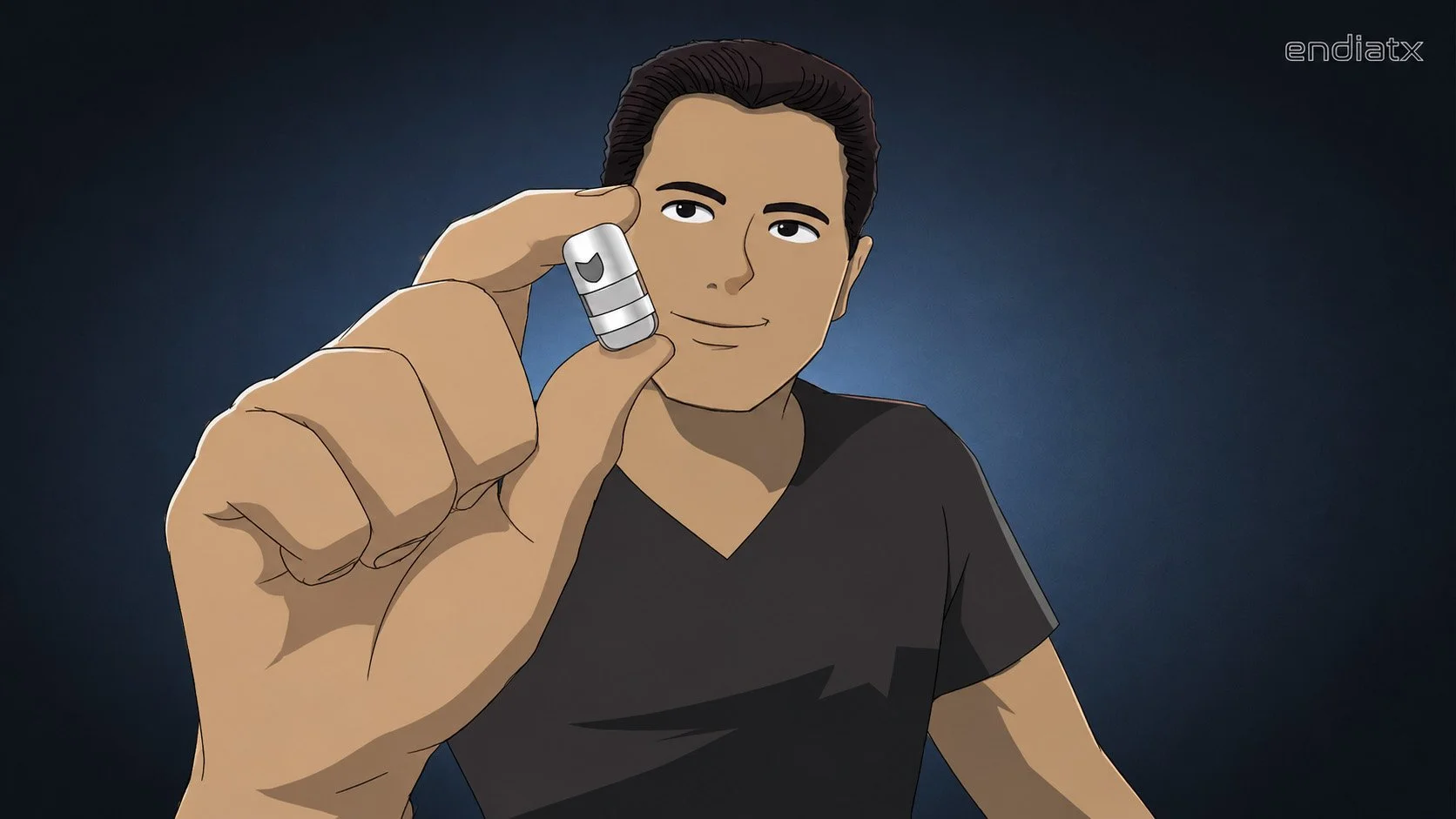
Imagine a miniature robot that goes into your body and streams live video of what's going on to a doctor. That is PillBot in a nutshell. Endiatx had everything a deep-tech startup dreams of — a working prototype, a remarkable invention, and a concept so intuitive it practically explained itself.
The communication challenge wasn't so much the concept. Science fiction — specifically, the Magic School Bus — had thoroughly done its job preparing us for this stage of medical science. The challenge was convincing investors that this was the team to unlock a $67 billion market — and convincing medical administrators that the technology was ready for the next round of clinical trials.
When I met Torrey to work on an explainer video, PillBot was already real, functional, and past proof-of-concept. But a working invention isn't a fundable company. The founders were still early in the clinical trial process, without FDA clearance, and competing for the attention of investors and medical administrators who needed to believe in both the technology and the team behind it.
noise
PillBot didn't have a communication problem in the traditional sense — the concept was immediately graspable, the technology was real, and the market need was obvious. The noise was upstream: without FDA clearance and with clinical trials still in progress, the founders needed to project credibility and momentum to two very different audiences simultaneously. Investors needed to believe in the team. Medical administrators needed to believe in the technology. The video had to speak to both without losing either.
signal
Investors needed to see a team serious enough to navigate a heavily regulated market all the way to commercialization. Medical administrators needed to see technology mature enough to justify the next round of clinical trials. The signal wasn't "look how remarkable this invention is." It was "this is actually happening — and these are the people who will make it happen."
Scope
The explainer script compressed a complex business case into under a minute of portable, confident storytelling. Rather than walking through the underlying technology, it moved directly from the patient's problem — multiple hospital visits, sedation, a tube — to the solution, to the market opportunity, to the competitive position. Rather than manufacturing demand, the video assumed it — and moved straight to the team and the path forward.
The result
The company kept moving. Endiatx raised a $2M Series A, bringing total funding to $21M since its 2019 incorporation. Clinical trials advanced toward completion, with FDA clearance anticipated for 2025 and a commercial launch targeted for 2026. The founder brought on a new CEO to lead the next phase. Along the way, Adam Savage, engineer, maker, and one of the most credible tech voices in popular culture, swallowed the prototype on camera. That kind of visibility can't be manufactured. It's earned — and it tends to find the companies that deserve it.

Production Notes
PillBot is the flying car. Nobody needs to understand how it works. Everyone immediately wants one. That instinct is what the explainer was built around — not explanation, but assumption. The concept was already in the culture. What it needed was compression and confidence.
What's harder than a remarkable invention is trust. Endiatx needed investors and medical administrators to see the company not as a promising idea, but as a serious, fundable, market-ready operation. The founders needed to demonstrate progress, commitment, and a credible path forward. That's a different assignment than explaining what the thing does.
The explainer brought together the patient problem, the technology, the market context, and the competitive position into something portable — a single artifact that could travel into a room and do its work without the founders having to narrate every piece of it.
Torrey Smith and his team deserve every ounce of the success that's coming to them. PillBot has the potential to revolutionize the medical industry — and the case makes itself across every audience it touches.
Anyone who has faced or fears an endoscopy will welcome it. Gastroenterologists and GI specialists get the diagnostic access of an endoscope without the procedural overhead. Hospitals and outpatient facilities see cost reduction, improved throughput, and reduced sedation risk. Medical device buyers and procurement teams see a potential disruptor in a $67 billion market they're already spending heavily in.
The clinical case writes itself.